Duke of Zhou
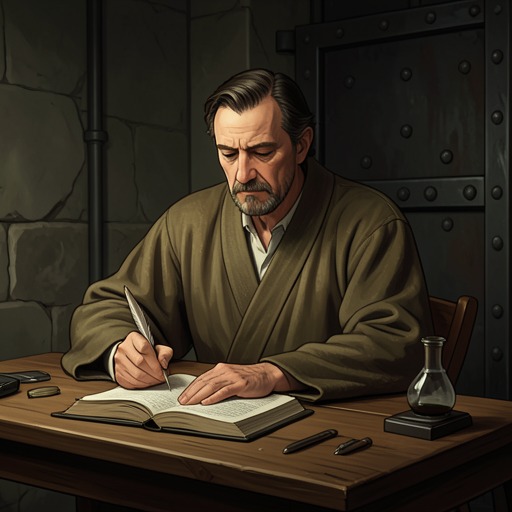
I ChingDuke of Zhou, also called Tan or Duke of Kâu, is described as the major contributor who completed the I Ching’s line texts after his father King Wen had interpreted the hexagrams as wholes. His work gives separate symbolic meanings to the six lines of each figure and draws political and ethical guidance from them. In the book’s account, the line texts are not merely divination formulas: their treatment of command, discipline, legitimate force, and appointment makes the figures a vehicle for thinking about the conduct of government.
Identity and Historical Setting
Duke of Zhou was King Wen’s son and a brother of King Wu, who succeeded their father and became the first sovereign of the Zhou dynasty. The account characterizes him as a patriot, hero, legislator, and philosopher, but does not explain what first led him to take up his father’s work. It offers filial duty as a possibility rather than a certainty: he may have continued the interpretation as a tribute to King Wen.
The text’s chronology places the completion of the I Ching in the late twelfth century BC. King Wen’s contribution is dated to his imprisonment at Youli in 1143 or 1142 BC; Duke of Zhou’s larger share followed thirty to forty years later. The book also observes that some passages refer to events in the early years of the subsequent reign, and notes that Duke of Zhou died in 1105 BC, the eleventh year of King Cheng. These details situate the work within the transition from Shang rule to the early Zhou, rather than in an undifferentiated remote antiquity.
Completing King Wen’s Work
King Wen’s portion, as the account understands it, consists of sixty-four short paragraphs, one for each hexagram. He names each figure and explains its significance as a whole, sometimes indicating what action its circumstances call for and whether that action is likely to bring good or bad fortune. Duke of Zhou takes up the same figures at a closer scale: beginning with the bottom line, he supplies an emblematic interpretation for each line, again relating action to its likely consequences. The king’s interpretation of a hexagram is thus meant to accord with the combined significance of the six line readings.
The commentary describes Duke of Zhou’s method as making each line seem to come alive. A line suggests a phenomenon of nature or a case of human experience, from which its wisdom or folly, and the fortune or misfortune of acting in connection with it, can be inferred. The result is a text of more than 350 emblems across the hexagrams. The original commentator judges many of them grotesque or dry rather than poetic, but argues that this effect should be understood in context: father and son wrote in the manner of diviners, even though the account does not regard them as divining for themselves. Their words later became oracles for readers who consulted the figures about whether to persist in or withdraw from intended courses of action.
Political Judgment in the Hexagram of Hosts
The seventh hexagram, Sze, or Hosts, illustrates how the line readings turn a figure into an argument about political and military responsibility. Its name joins the idea of an army to that of a population liable for military service; the figure itself consists of water gathered on the earth, an image associated with assembled multitudes. The interpretation identifies the strong second line, centrally placed in the lower trigram, as the leader of the hosts. The arrangement gives the military question a political structure: authority must be located, recognized, and exercised under proper conditions.
Duke of Zhou’s first line warns that an army’s departure must follow the rules for such a movement; without sound rules, the outcome is adverse. The commentary notes two readings of those rules: they may concern the justification for a campaign, such as suppressing disorder and rebellion, or the discipline troops are required to observe. Either way, the line makes military action conditional rather than automatically praiseworthy.
The second line presents the leader in the midst of the army, with good fortune and no error, because the sovereign has entrusted him with authority and his command faces no opposition. The fifth-line reading sharpens the limits on that authority. It approves destroying the symbolic birds in the fields, interpreted as plunderers and invaders, but warns that a divided command—an eldest son leading while younger men also exercise command—brings evil even if the leader is firm and correct. The commentary reads this as support for defensive war or action by rightful authority against rebellion and lawlessness, and as a warning against allowing subordinate commanders to divide the chief commander’s power.
At the hexagram’s top line, the great ruler distributes appointments to those who have distinguished themselves, making some rulers of states and others chiefs of clans, but must not place small men in such offices. Read together, the military lines link legitimate force to disciplined procedure, trusted command, a defensible purpose, and responsible appointment. Victory is not the sole test; the conduct and political settlement that accompany it matter as well.
Historical Interpretation and Limits
The book connects Duke of Zhou’s symbolism with the unsettled period following King Wu’s accession, when King Wu’s son King Cheng was on the throne and Duke of Zhou was regent. It asks whether at least one symbolic passage should therefore be dated to that troubled regency. This is presented as an inference from the commentary’s historical circumstances, not as a date established by the text itself. In the same discussion, the Kangxi editors interpret a concluding image as a lesson in humility: the duke is content to leave birds in flight and reserve his arrows for those in a cave.
The account distinguishes the early work from later philosophical systems imposed upon it. In discussing yin and yang, it argues that the I Ching’s subject is the changing phenomena of nature and experience, not a fully developed theory of primordial matter or cosmology. Such a doctrine, it says, took shape in the Confucian school more than a thousand years after the text’s completion and was not fully developed until the Song dynasty. This distinction frames Duke of Zhou’s contribution as symbolic and practical: his line readings interpret changing circumstances and human conduct, while later commentators may give those symbols a philosophical reach beyond what the historical account finds warranted.